All posts by Jeff

TTE 550 vs TTE 600

The TTE 600 turbocharger has not been one that I’m interested in obtaining due to the RS6 turbine housing that it uses necessitating a different downpipe or flange.  Still, I was curious how it would compare with the TTE 550 model and when I came across a set of dyno sheets from MRC Tuning showing one RS4 with the TTE 550’s and another with the TTE 600’s I decided to match them up.

A quick scan of the product descriptions shows that the TTE 600 is an RS6 K04 based turbo with a larger compressor wheel and some refinements made to the turbine wheel utilizing the RS6 turbine housing.

The TTE 550 is one of the candidates I’m considering and uses the same internals as the 600, (so far as I can tell), but packages them in the RS4 K04 housing, so the smaller K04 turbine housing.

It would appear the the main difference is the turbine housing, RS6 vs RS4.

Results:

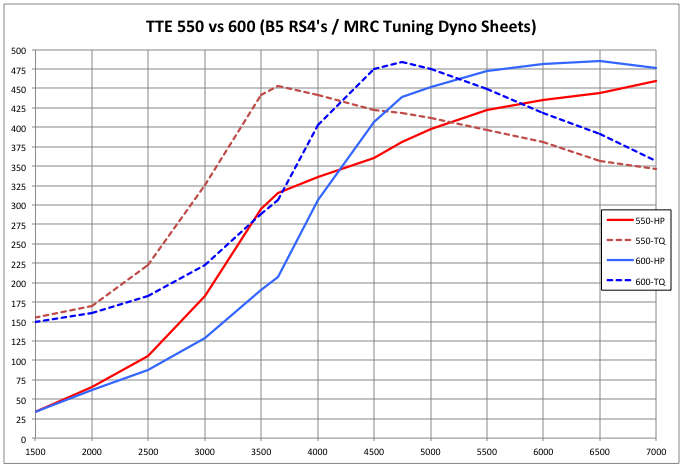
I pulled some data from the dyno charts and after converting them to post-drivetrain loss at the wheels HP and Ft-Lb units I plotted them out.

Here’s how they compare:
tte550_vs_tte600

The results are generally what one would expect to see given the physical differences in the turbochargers.  The smaller 550 generates torque more quickly and the larger 600 is able to develop additional power at upper engine speeds.

Of interest to me is just how much greater the torque produced by the 550 is below 4000 rpm.  At 3000 rpm the 550 car is making 100 ft-lbs more torque, growing to about 160 ft-lbs more by 3500 rpm.

I decided to take a look at the ‘area under the curve’, the term describing the overall torque being produced across the engine speed spectrum.  Using a trapezoidal numerical integration at 500 rpm intervals the ‘area under the curve’ was remarkably close for these two turbochargers.  The TTE 550 edges out the 600 by about 3%.

Conclusion:

The results shown here have reinforced my belief that the TTE 550 is probably the best product from the TTE lineup to achieve the goals I have for my S4.
Big power FT21’s

During some of the recent activity showing the TTE 550’s and FT21’s on E85 tunes I forgot about this car’s results.  While the survey results thus far would indicate more are interested in quick spooling of the turbocharger, under the condition I outlined, it is still fun to look at what can be accomplished with these K04 hybrid turbochargers.

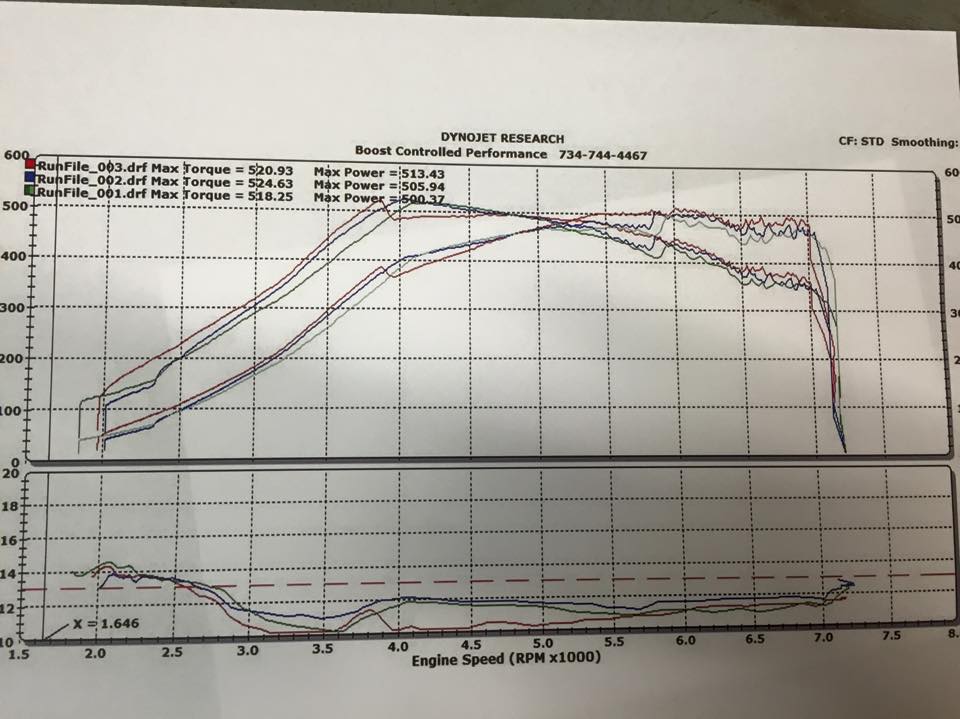
The S4 dyno’d below has the FrankenTurbo FT21 turbochargers, aftermarket rods, 2.8 cams, and using E85, no WMI.

Frankenturbo F21 E85 Dynojet

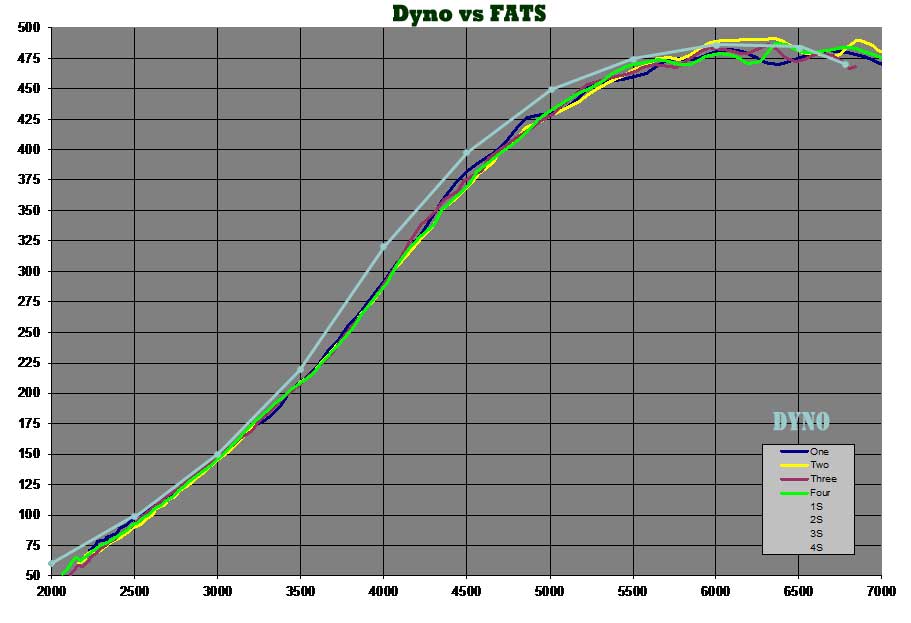
The car was also recorded on a FATS pull, a nice cross check to see how ‘legitimate’ the dyno numbers are.  It managed a 2.63 time in that acceleration exercise, which corroborates well with the dyno results.  Based upon the two results it would seem that around 500 whp is a decent estimate for the car’s power.

My personal experience with comparing FATS to dyno numbers has been positive, I found when comparing my TiAL 605 setup on 100 octane race gas during a FATS pull with the results produced on EPL’s Mustang dyno that the two matched up quite well.

In the chart below the light blue line is what was recorded on the dyno (shown further down the page), and the other colored lines were FATS pulls of 2.69-2.71 seconds.

605 100 Octane Race Gas; FATS vs Dyno Results Compared

From the dyno chart below I have extracted the numbers for the solid red line to plot versus the FATS line above.

TiAL 605 results. 93 and 100 octane tunes. Stock S4 motor, no WMI.


Wacky Turbo Comparisons

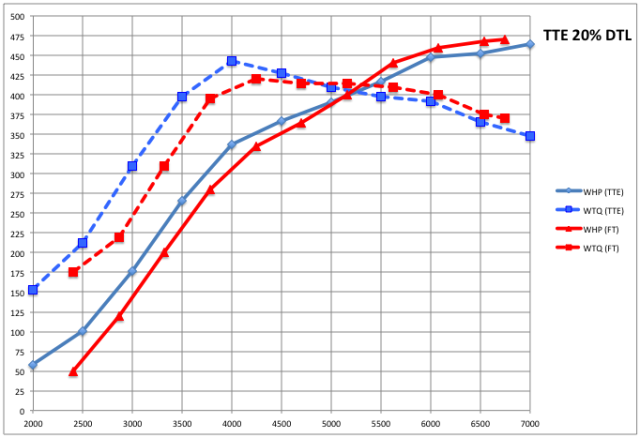
Within the last few days a couple of dyno charts have been put forth showing some impressive performance from the TTE 550 and FT 21 turbochargers.  Since both of these turbochargers are strong candidates for going onto my B5 S4 I decided to try and match up the results.

This is an exercise that must be approached with a great deal of consideration for the significant differences underlying the dyno charts.  These differences include:

  1. The dyno’s the cars were recorded on
  2. The conditions when they were produced
  3. The way measurements are reported
  4. The cars
  5. The fuel

There are enough points of difference here that a comparison should only be considered a ballpark estimate for how the turbochargers may compare under more controlled conditions.  Those more controlled conditions will hopefully be realized on another day, so for now I’ll charge onward with a crude comparison.

What I do know about the respective charts and vehicles.  The TTE 550 turbo’s were installed on a well modified B5 RS4 operating on 99 RON fuel with WMI spraying washer fluid.  The dyno chart displayed results at the engine, using an approximate 20% drivetrain loss.

The nature of the dyno readings meant that I needed to convert from NM to ft-lbs, and also apply the drivetrain  loss, more calculations than I’d like to do when trying to match performance, but necessary given the way data was presented for each vehicle.

The FT 21 turbochargers were installed on a stock motor B5 S4 operating with E85 fuel.  Dyno recording was made on a Mustang dynamometer and reported at the wheels.

And the comparison results…

tte 500 versus ft 21 dyno results
TTE 550 comparison with FT 21

Based on these *rough* curves it looks as though these two turbochargers match up well, but this comparison is far from being definitive.