Prior to installing a turbocharger on my S4 I make an effort to flow test the turbine side to see how it compares with the other turbochargers that I have tested.
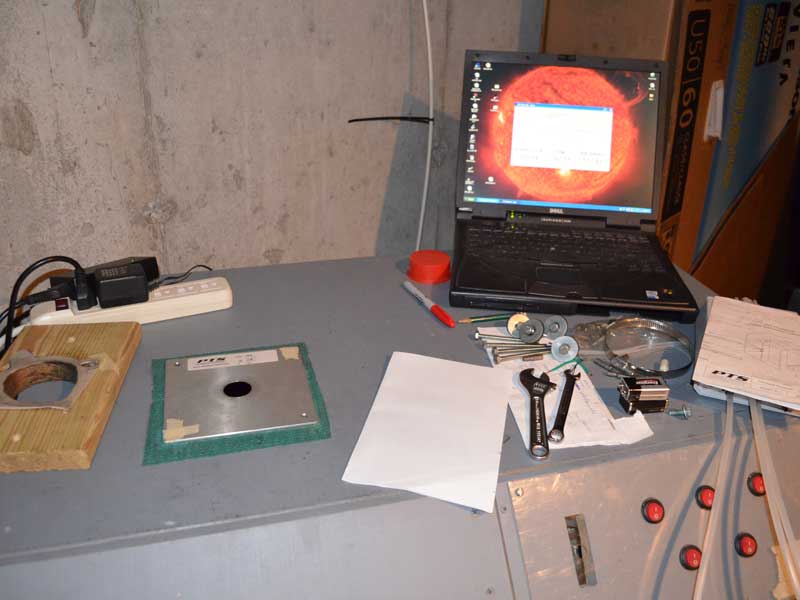
For this test I run a 100 CFM calibration plate since it is the closest to where these turbo products fall out, generally around 45-55 CFM at 28″ of H2O.
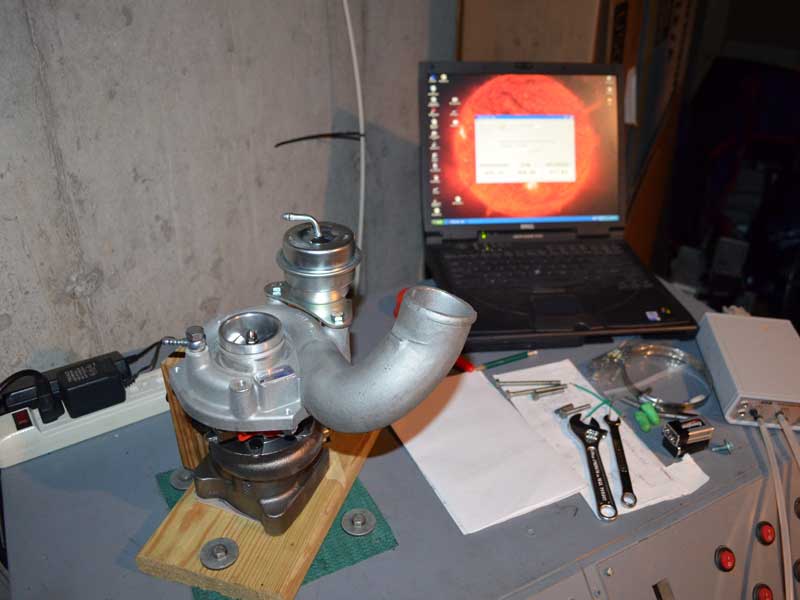
Turbo Concepts Stage 1 Turbocharger on Flowbench
After performing the bench calibration I place the turbocharger onto an adapter for transitioning to the flowbench. The compressor wheel is fixed in place, I hold it still with a finger, and then I slowly run the flow bench up to 28″ recording several data points along the way.
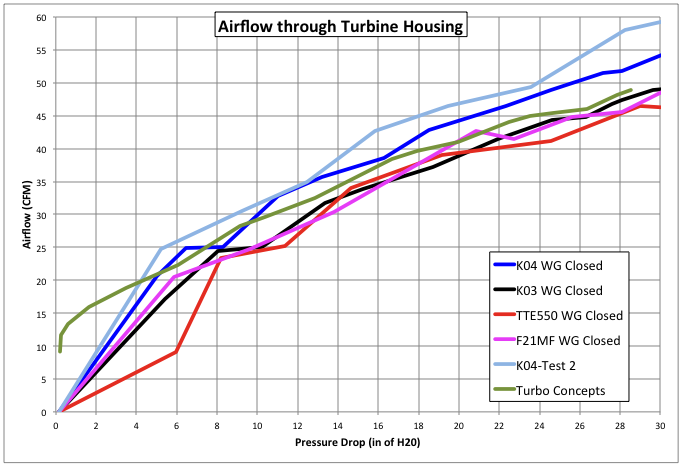
The chart above is a consolidation of the various turbochargers that I have tested thus far. Of note, the BorgWarner RS4 K04 has been the highest flowing turbocharger that I have tested.
The Turbo Concepts Stage 1 performed similar to the FrankenTurbo and Turbo Engineers products, as well as BorgWarner K03’s, still below where the K04’s placed.
While this is a test that I don’t put a lot of stock in to give insight into how the product will perform on the car, it is notable that the exhaust backpressure measured on the vehicle has been lowest with the BW K04’s, supporting the flow bench measurement.
It was a little over 18 months ago when I was trying to determine what affect a turbocharger blanket would have on spool up that I defined a measurement called the 2-11 time. The initial discussion of this measurement centered on how I determined what the measurement would be of, but not why I thought this measurement was useful for comparing the responsiveness of different turbochargers.
Recent discussion about the measurement has given rise to some questions that provide a good opportunity to look more closely at the 2-11 time and consider if there are alternative measurements that may be better at expressing the turbocharger response characteristic it tries to represent.
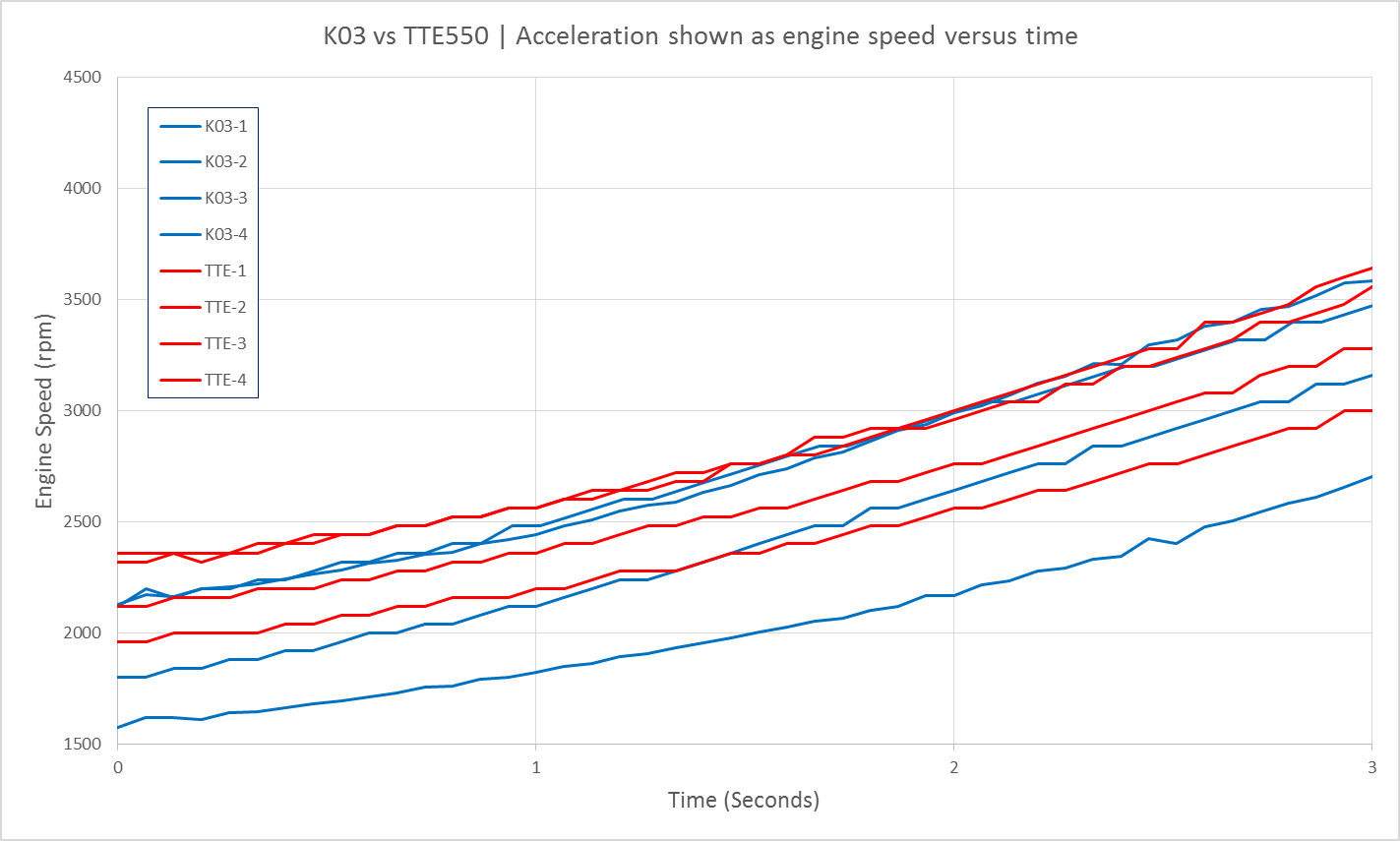
One of the first questions was “why not measure vehicle acceleration? ” Fair enough. When I asked how the data should be presented it was suggested to use rpm vs time, as a line graph.
Here’s a sample of how this would look for the first couple of seconds of a few pulls:
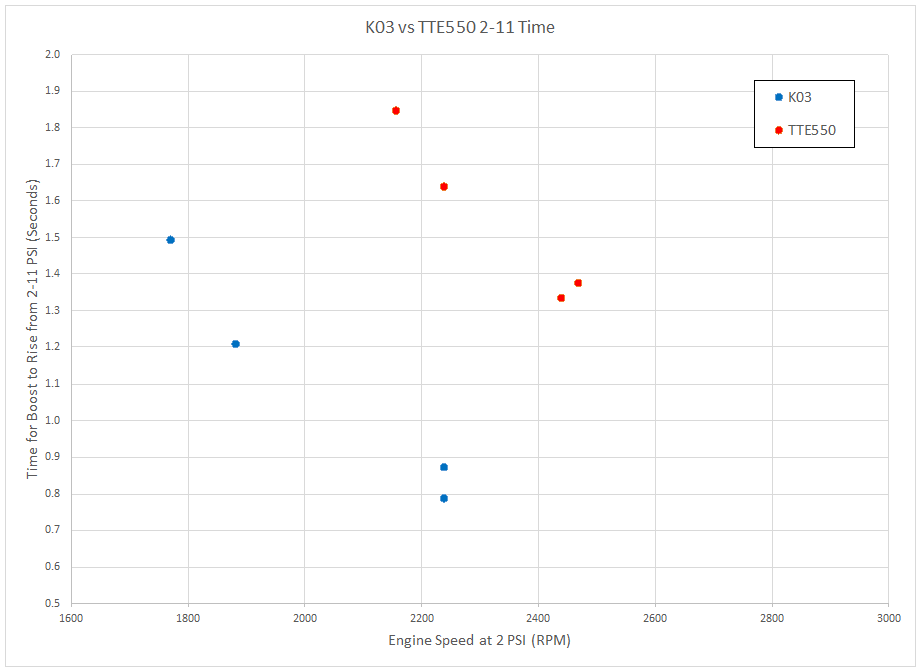
This to me is not particularly clear, at least not with respect to which setup is more responsive. Putting these pulls into the format I’ve chosen, the data for these two turbochargers looks like what is shown below:
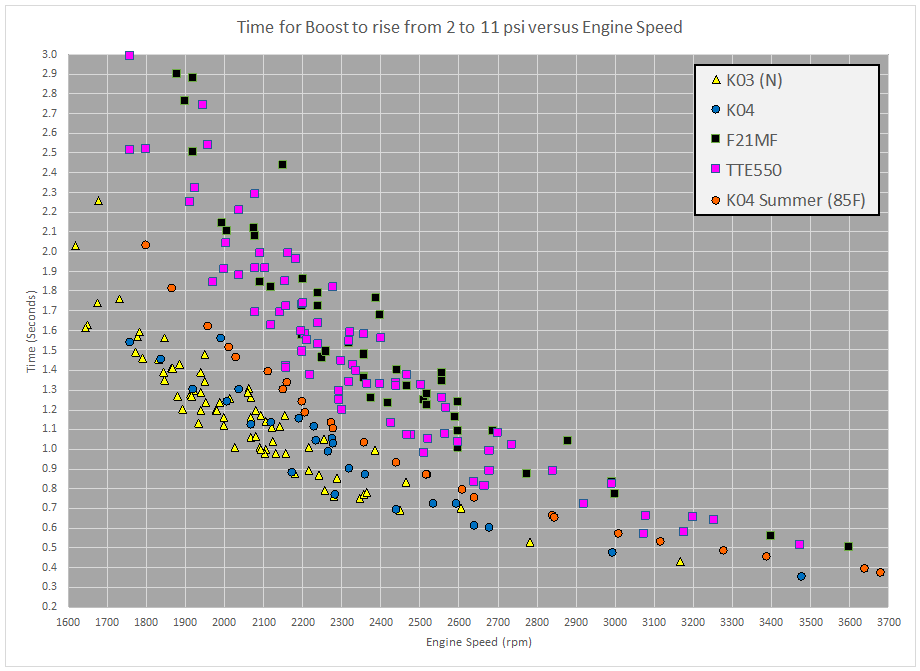
Another advantage is the amount of data that can be represented while still being able to differentiate between the products. The chart below has 255 pulls shown, if I were to try and put that many acceleration curves on a chart with lines it would be incomprehensible.
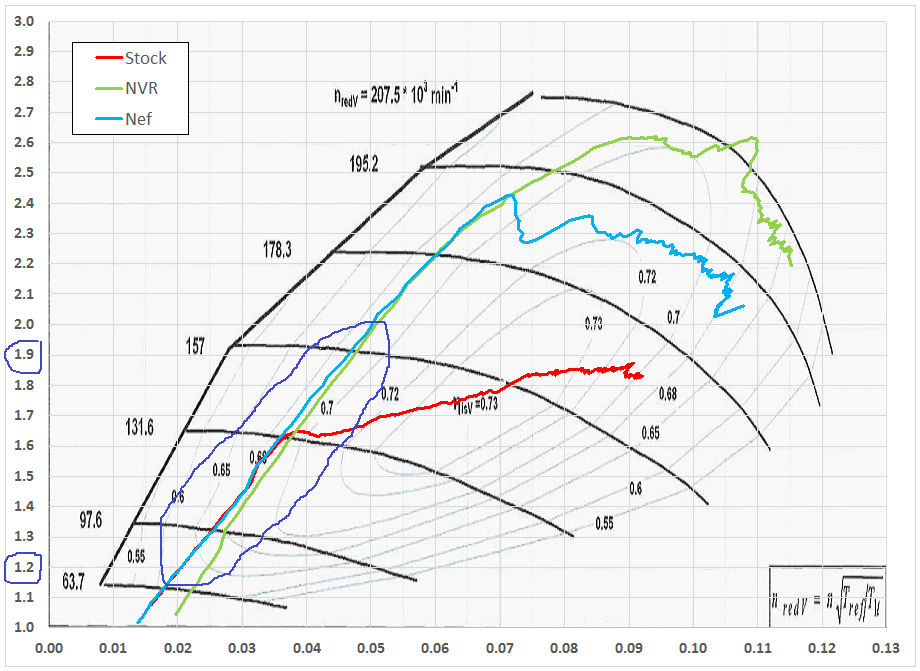
the pressure ratio, (turbocharger outlet pressure divided by the inlet pressure), does generally rise with the increasing rotation of the compressor wheel, and the manifold pressure is a result of the turbocharger outlet pressure, after some of the intake piping pressure losses are taken into account.
While rising boost pressure is not a perfect substitute for the rotational rate of the compressor wheel, (the line of boost pressure rising is not parallel with the left hand speed line), it is pretty close, and it is an adequate substitute for my purposes.
The 2-11 psi range is approximately 1.2 to 1.9 on the PR axis.
How about measuring the rotational rate of the compressor wheel, could that been done? Yes. Garrett sells a speed sensor kit that retails for around $450. It involves machining the turbo’s compressor housing so the sensor has a line of sight to the compressor wheel. Unfortunately it will only be good on a single turbocharger, and as my effort has involved multiple turbochargers this is not a cost effective option. Of course if someone is willing to fund the effort to purchase and install these systems on multiple turbochargers and then pay for the altered turbo’s they should contact me to make arrangements.
Yet another concern related to the affect other variables may have on the outcome. This is something that I make a reasonable effort to control, but have limitations to work with. A comment made to me was in relation to the vehicle weight and is worth looking into further:
“the weight of the car will effect turbo performance the same as overall acceleration. Weight = load. Load = drive. Drive = boost. Every variable you have mentioned being afraid of skewing the acceleration test is also skewing your spool testing”
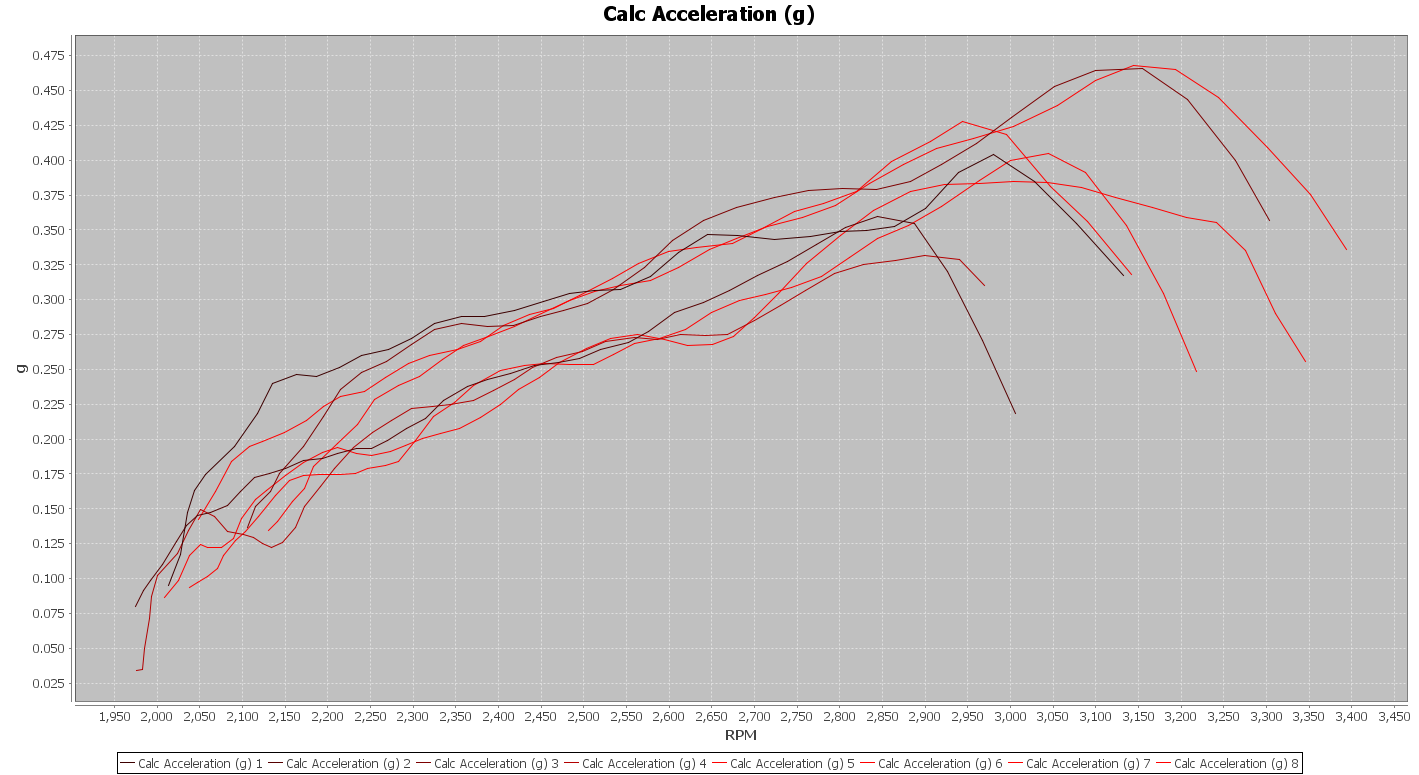
Rather than load the car up with extra weight I decided to simulate a weight change by performing a series of pulls going uphill, and a series going downhill. Then using ECUxPlot I’ve graphed the calculated acceleration (g’s) versus engine speed for each pull, shown below.
Uphill vs Downhill Acceleration
The affect of the road angle on vehicle acceleration is clearly evident.
How about the affect on boost?
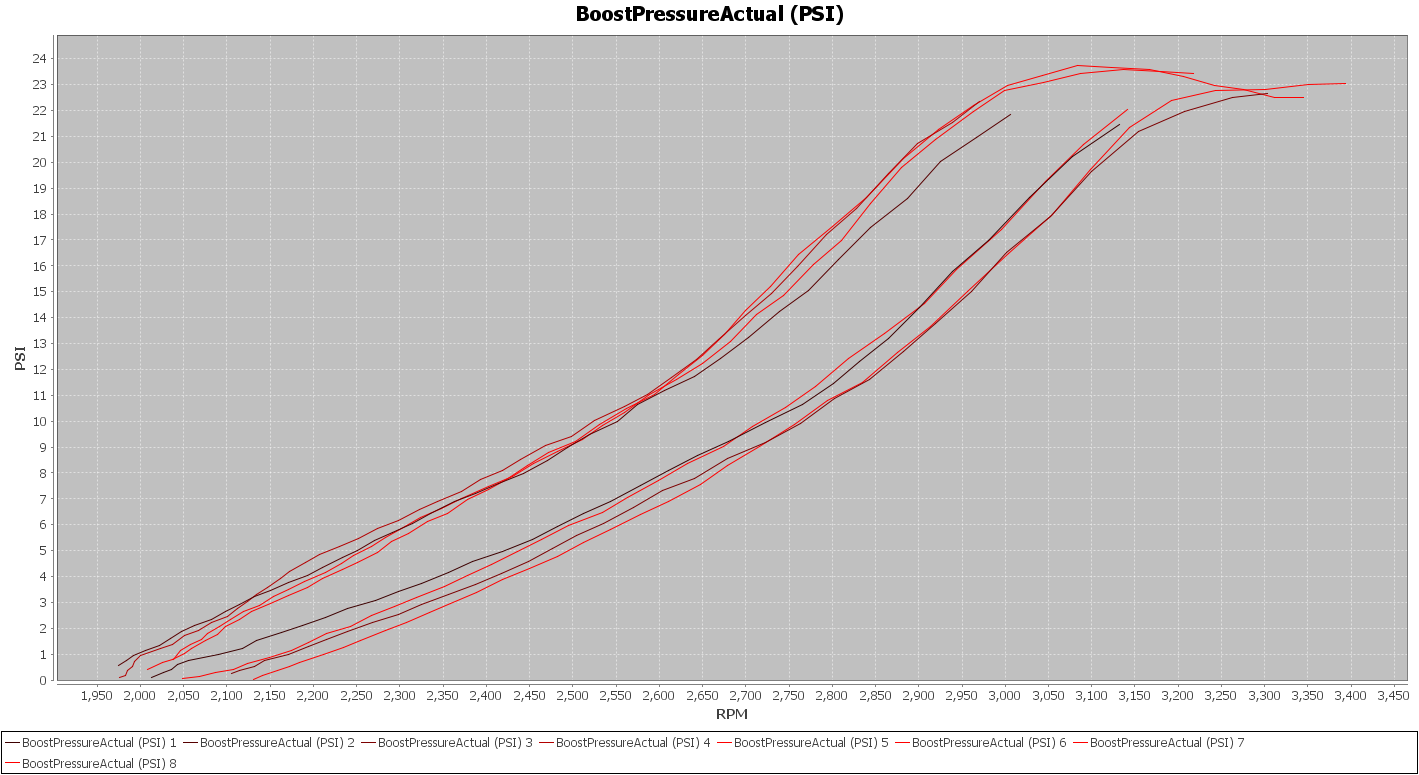
Manifold Boost Pressure
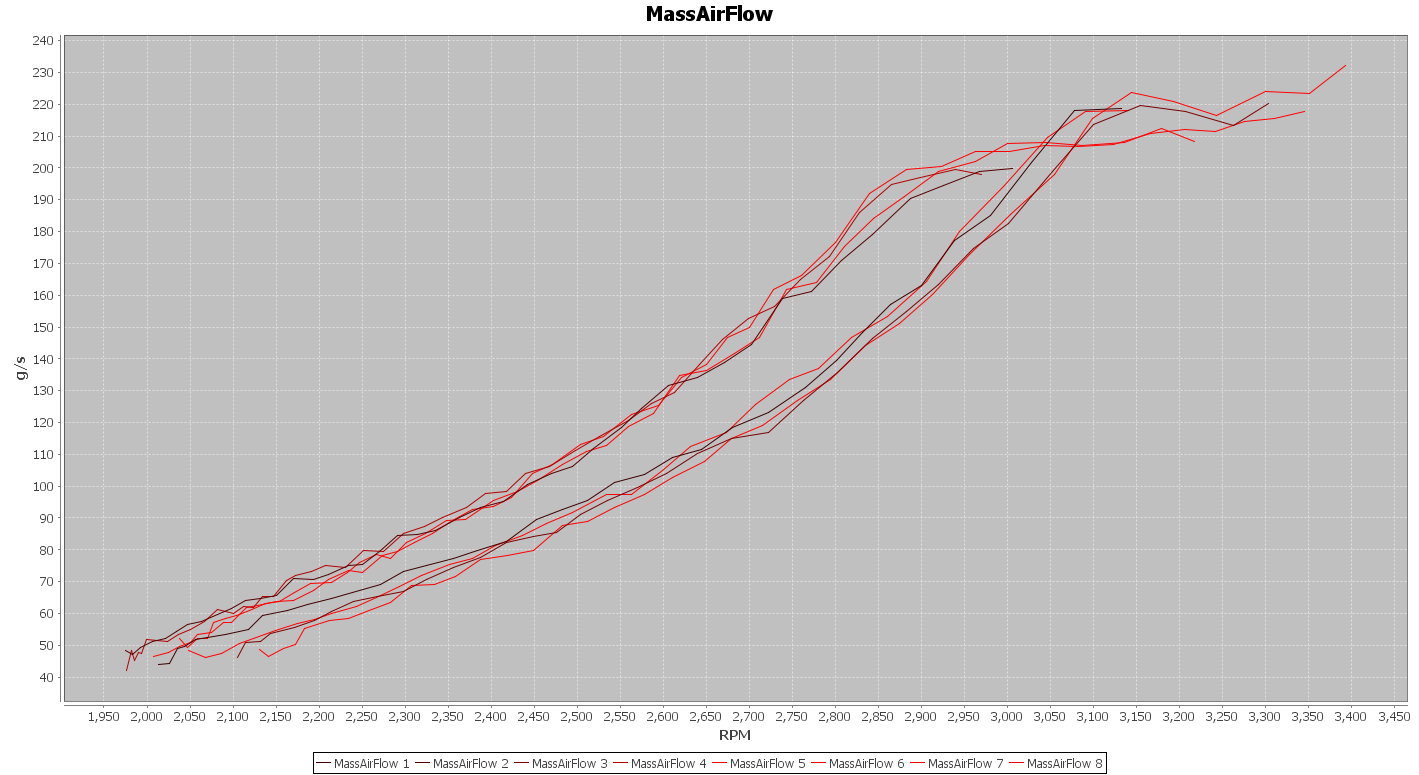
Or if you prefer, airflow:
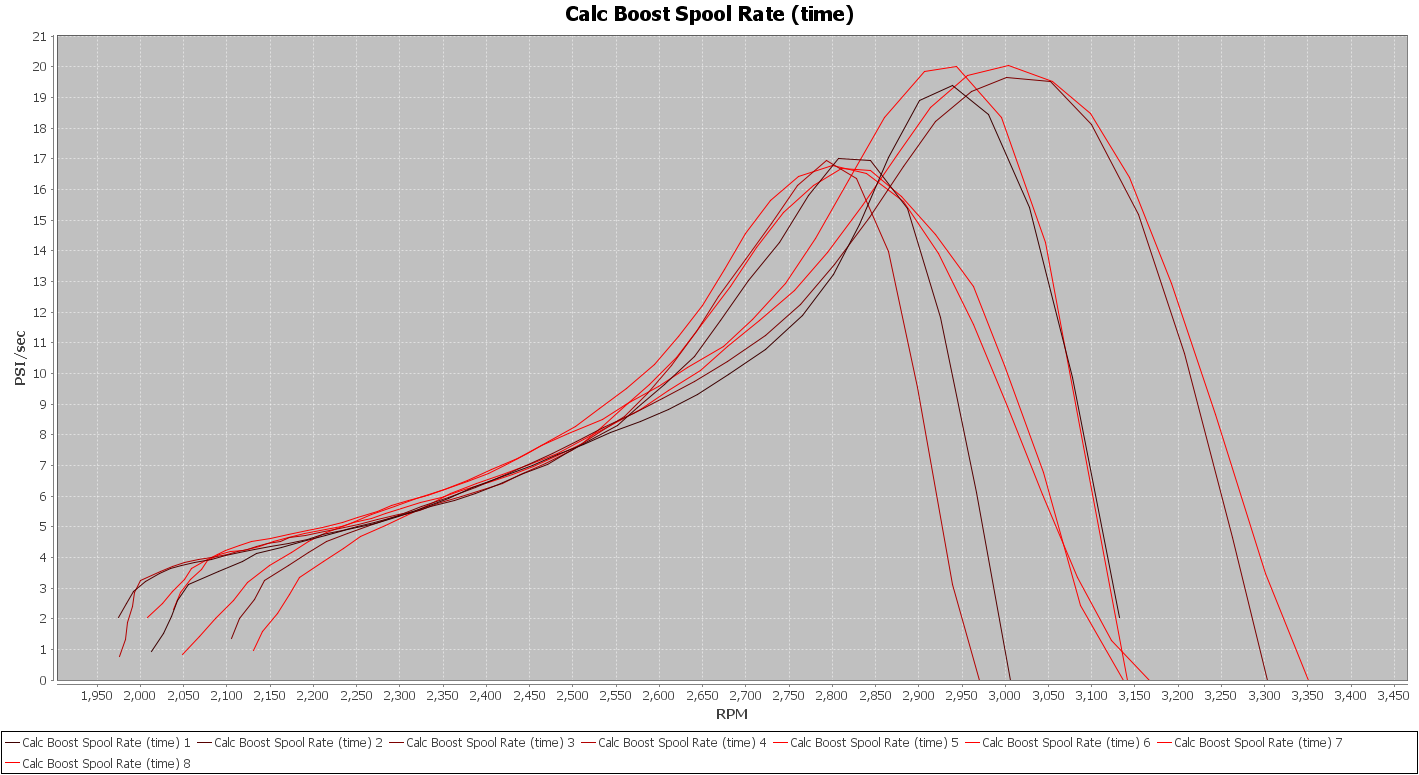
I believe that these measurements are strongly influenced by the road angle variable. But how about spool rate? This is what ECUxPlot calculates:
Turbocharger Spool Rate
The two conditions, uphill and downhill, only start to break out into distinctive trends around the 9-11 psi/sec (2600-2700 rpm). On the boost only chart this occurs when the boost curve is between 9-11 psi for the two road conditions. Spool rate is not affected as much by the road angle as the acceleration curves are.
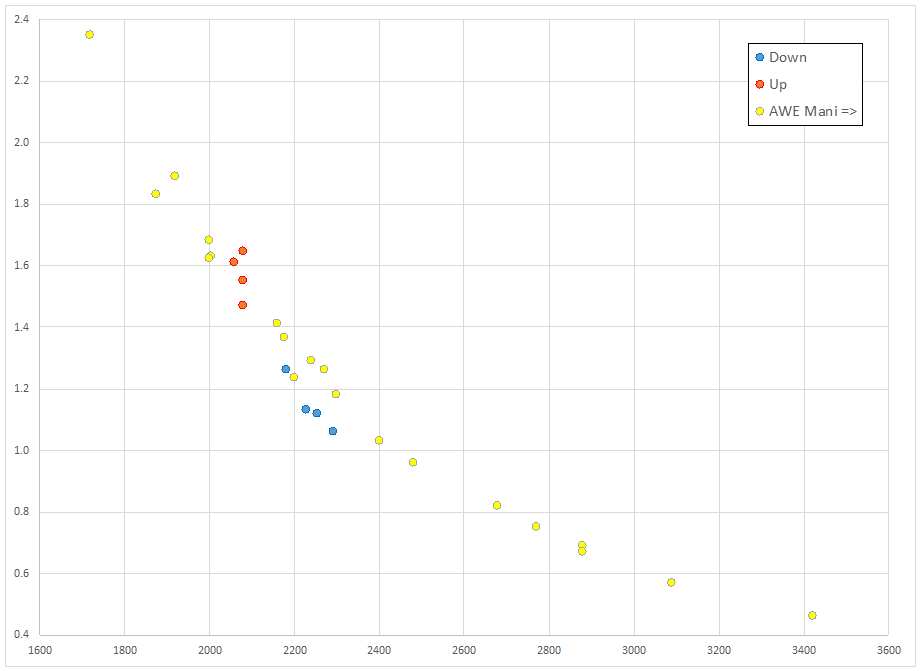
Placing this series of pulls into the format I have chosen gives the following result:
Downhill appears to have a slight influence on the time, while uphill looks to follow the trend line for all of the data points.
The bottom line from this investigation is that I now feel the 2-11 time is less sensitive to vehicle weight than acceleration, dispelling concern raised about how spool and acceleration are equally affected by the vehicle weight.
Going forward it is worth considering the concerns raised about measurements such as this, but it is also important to weed out and ignore uninformed objections or those that are raised out of spite.
Several months ago I mentioned that Turbo Concepts was a vendor I was interested in learning a bit more about. The information I could find at the time was looking promising based upon the marketing information, but I was hoping to find some user data on the Stage 1 offering.
Turbo Concepts DZX-271
Turbo Concepts (TC) was cooperative in providing me with some on car data, unfortunately the results were from the middle of the summer (hot temperatures), and on a Tiptronic equipped car, so the tune was not very aggressive. The information was inconclusive; it did not show the turbo’s being able to produce full boost by 2800 rpm, something the larger Stage 2 turbo is claimed to do and so a benchmark that I would expect the smaller Stage 1 turbo to equal, or exceed.
For reference, BW K04’s under favorable temperature conditions can reach 20 psi by 2800 rpm. The BW K04 is also advertised to flow about 21 lbs per minute, by comparison the TC Stage 1 product is claimed to deliver up to 28 lbs. per minute.
Outflowing the BW K04 yet retaining the same response is just what I have been after as part of my search for the best stock motor turbo. A search that has yet to uncover a turbocharger capable of equaling the responsiveness of the BW K04. The Turbo Concepts Stage 1 turbocharger is unique among turbochargers I have come across as it is targeted as a direct replacement for the RS4 K04. During my search of the K04 alternatives the information I have found shows that most of these K04-hybrid options are a decent bit larger than RS4 K04’s, and so far have failed to meet RS4 K04 responsiveness.
While inquiring about the TC Stage 1 product they had informed me that they were in the process of incorporating a revised turbine wheel design in their products and that the new turbine wheel was expected to bring an increase in responsiveness, this was encouraging news.
The Stage 1 turbochargers are now available with the latest turbine wheel and I’ve decided to see if this product lives up to the manufacturer’s claims, those being:
BorgWarner RS4/K04 responsiveness
Outflow the BorgWarner RS4/K04 by 20% (28 lbs/min)
Up to 450whp on pump gas
I also plan on assessing how it compares with the other turbochargers I have evaluated on my B5 S4.
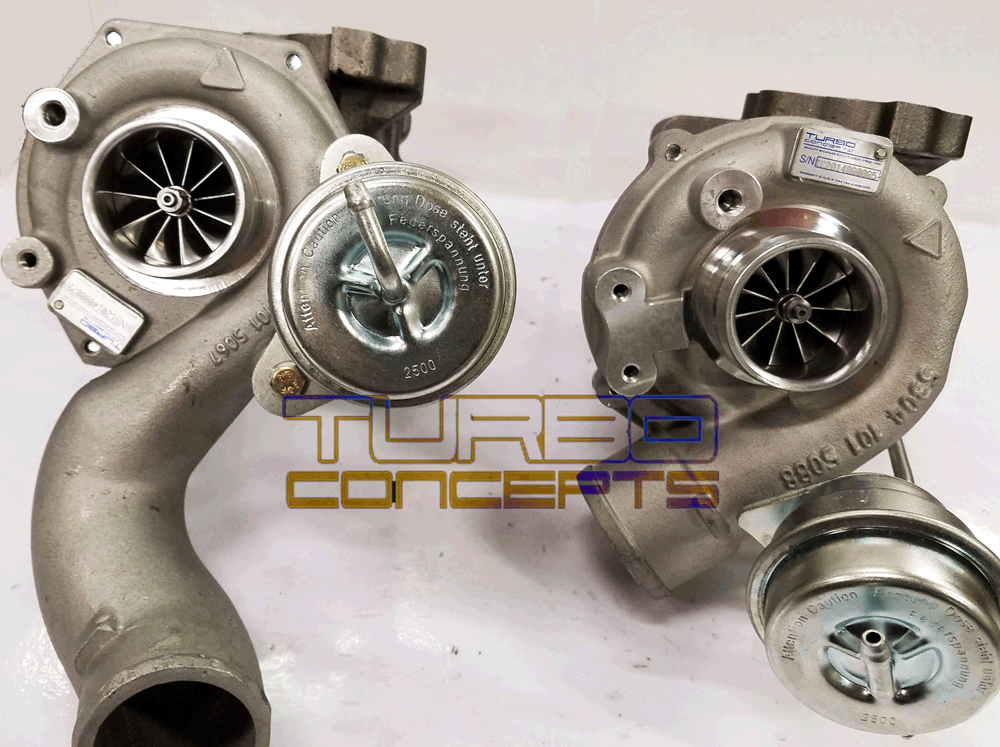
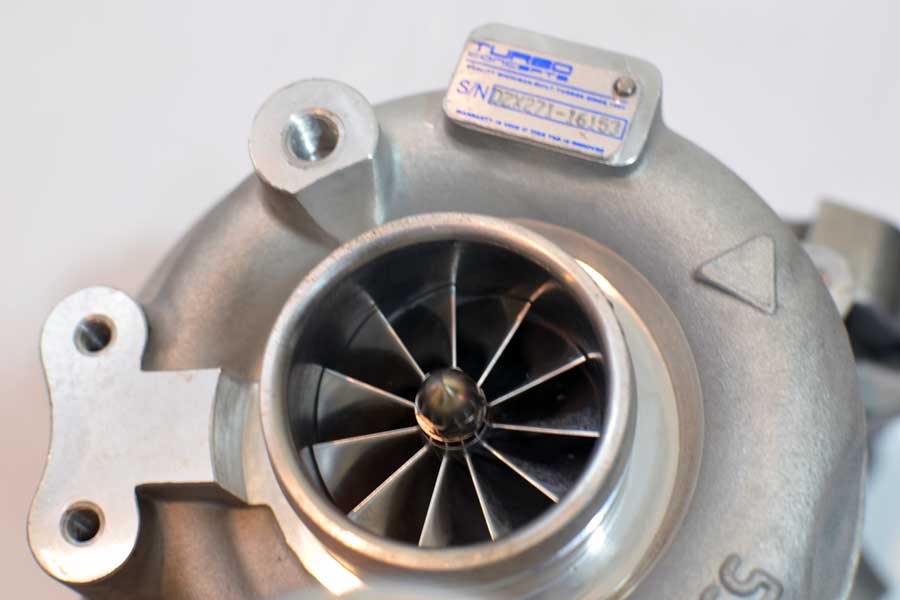
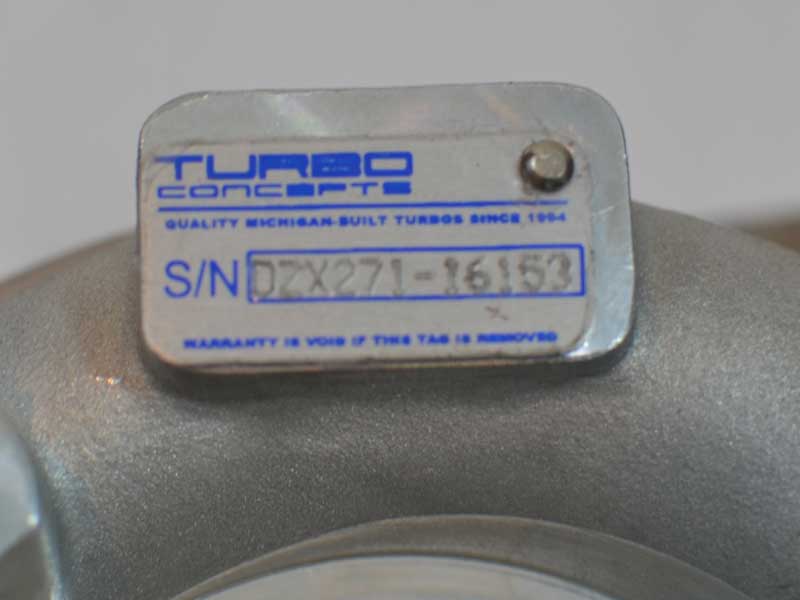
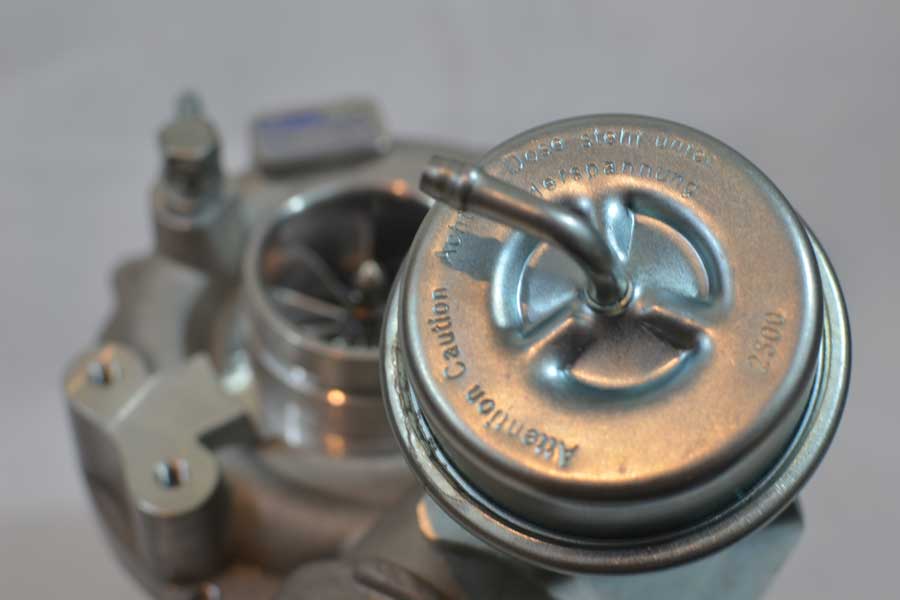
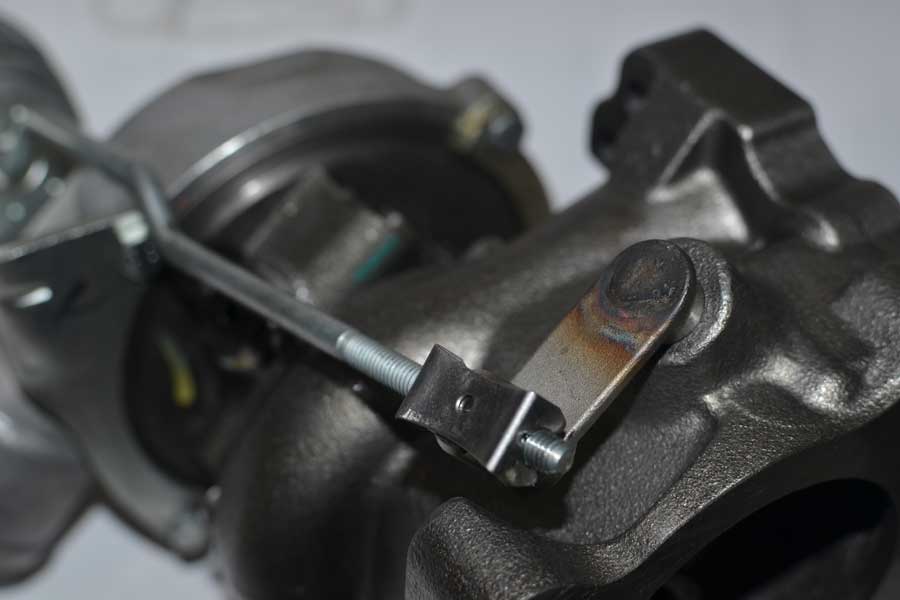
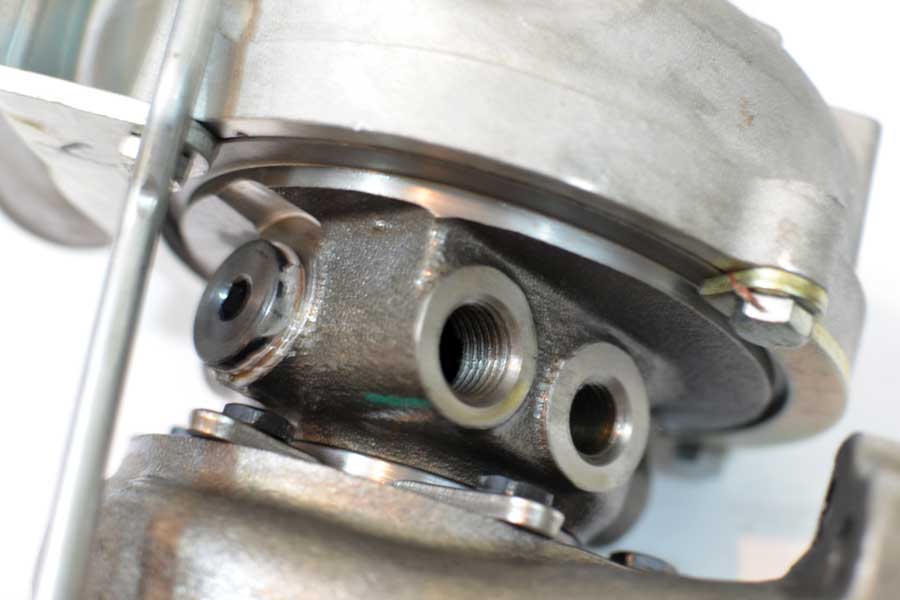
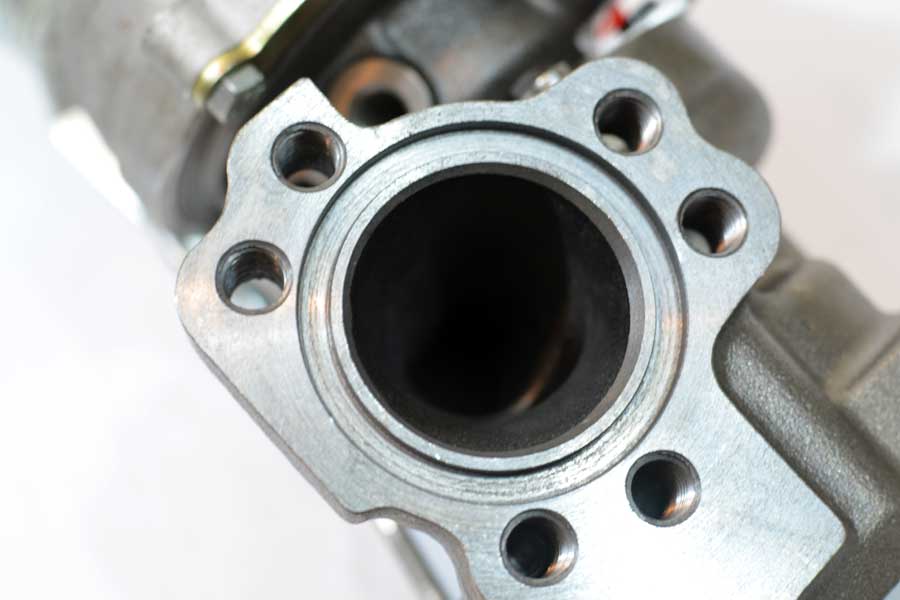
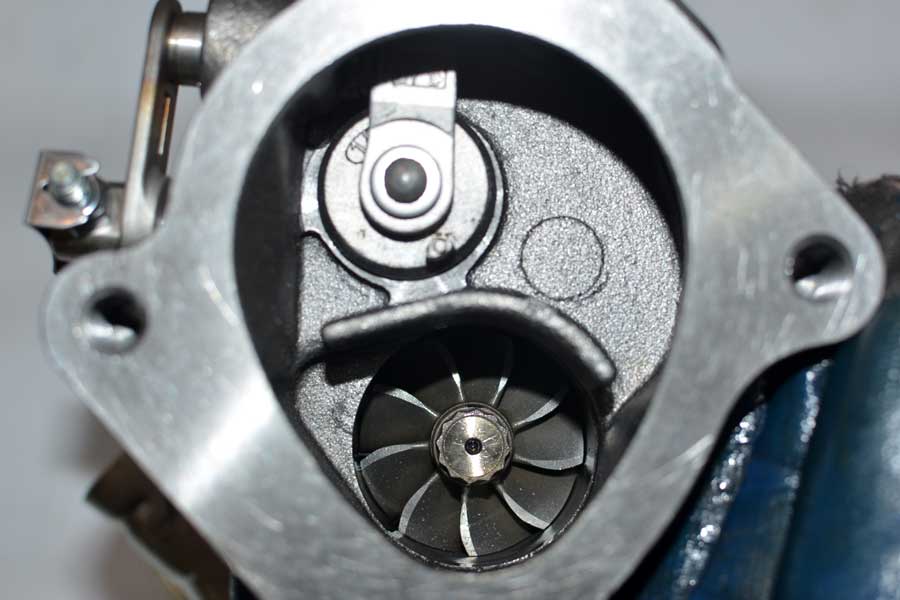
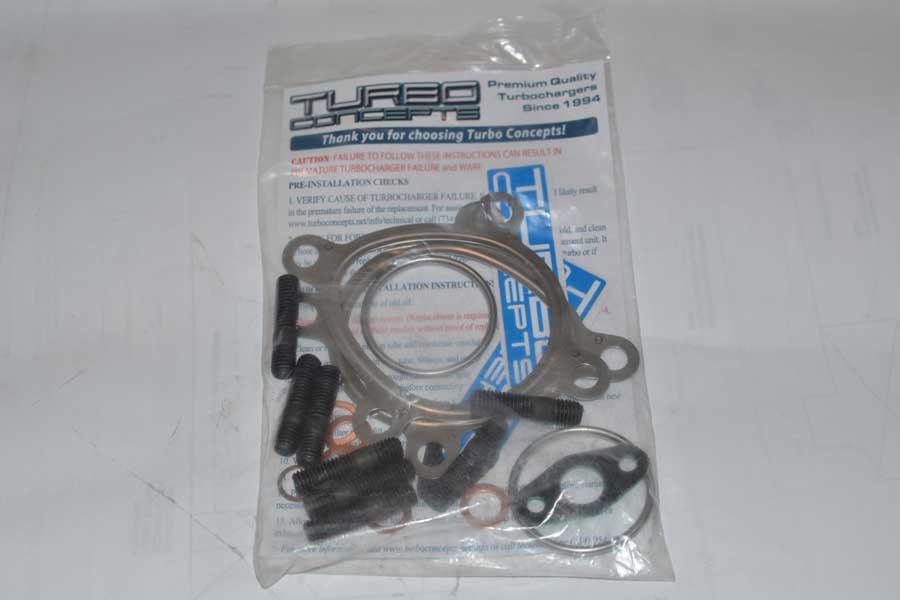
The following are photographs of the Turbo Concepts DZX-271 Turbochargers that were delivered.