All posts by Jeff

A-Pillar Boost Gauge

I got around to re-installing the A-pillar gauge pod and boost gauge today.  I have it tied into the turbo compressor signal line so I get pressure at the compressor, the downside is all I get is positive pressure, no vacuum.  Eventually I’ll run this line elsewhere and have the compressor signal line going to a data collector.
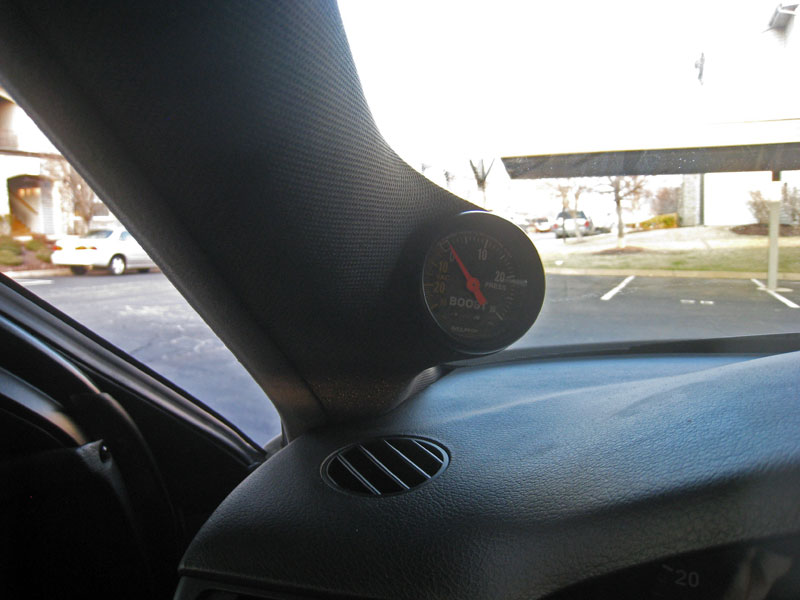
SPP A-Pillar Gauge Pod

I also went and made a short log just to evaluate whereabouts the stock tune lands on the BW K03 compressor map.  There’s room to expand here:
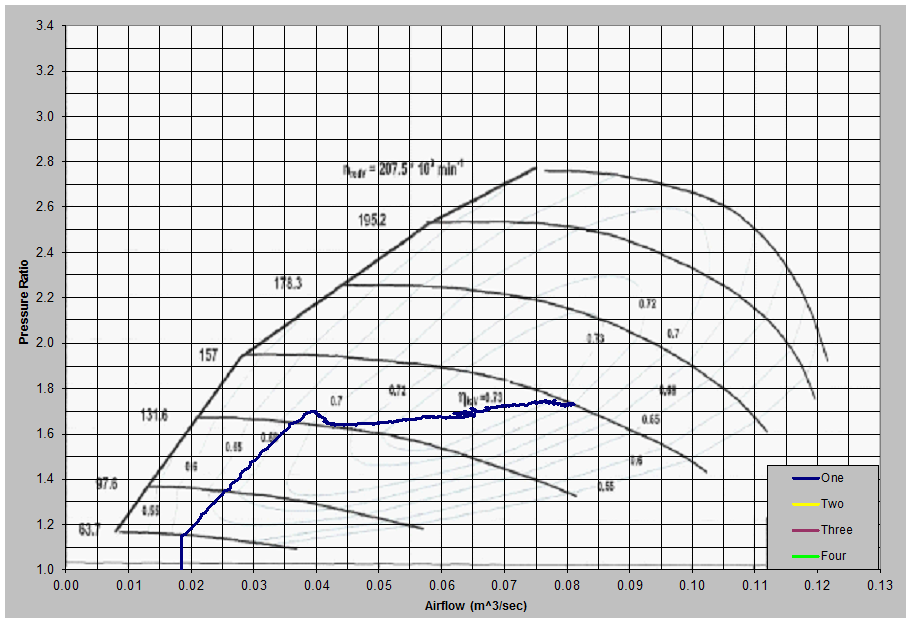
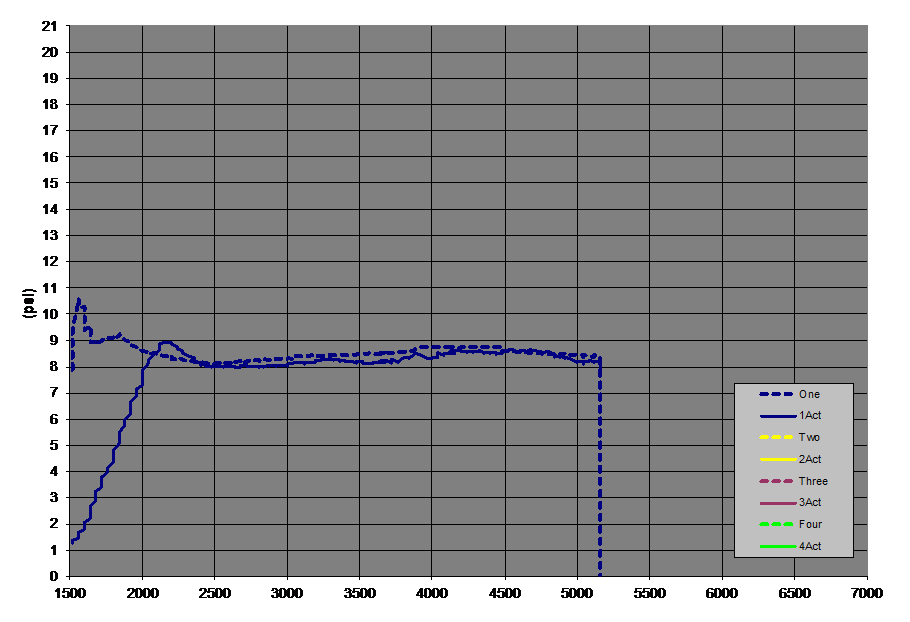
k03_comp_chart_overlayAs expected the boost comes on quickly; for comparison a K04 size turbo would reach the 8-9 psi mark about 500 rpm later.
k03_boostFinally, I was a little surprised at how flat the IAT’s were.  This is on stock boost levels, but I had spent a couple of minutes sitting at lights before making this log and normally with other turbo’s (larger and more boost), I’d be seeing a decent climb in the intake temps.  The takeaway here is that for how the car was built by Audi to be operated the stock IC’s look to do a fine job.
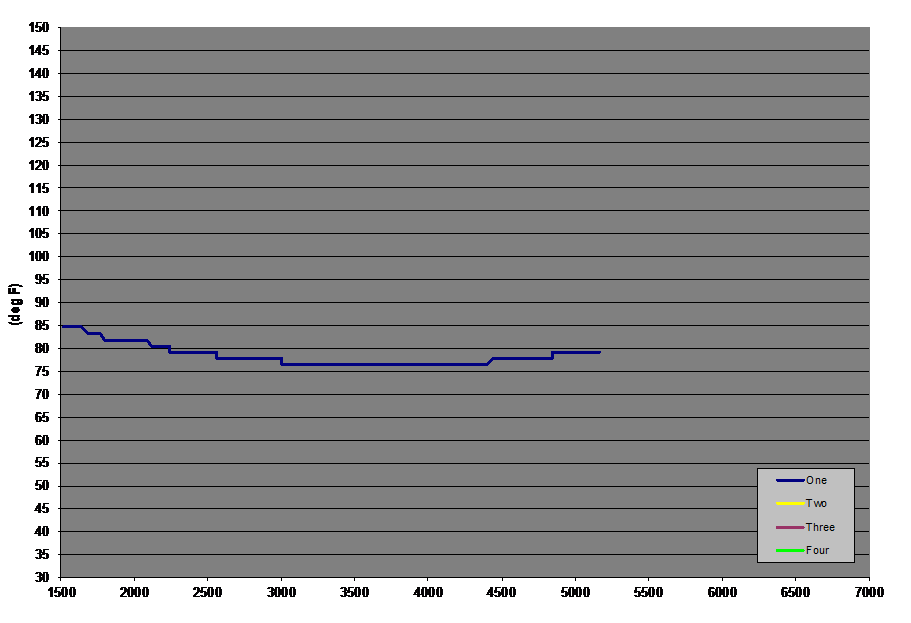
Stock IC and Stock Tune IAT
Stock IC’s and Stock tune with BW K03’s

Lastly, my hope is to soon get this thing connected so I can test out the Eurodyne BoostManager Water/Methanol injection system.
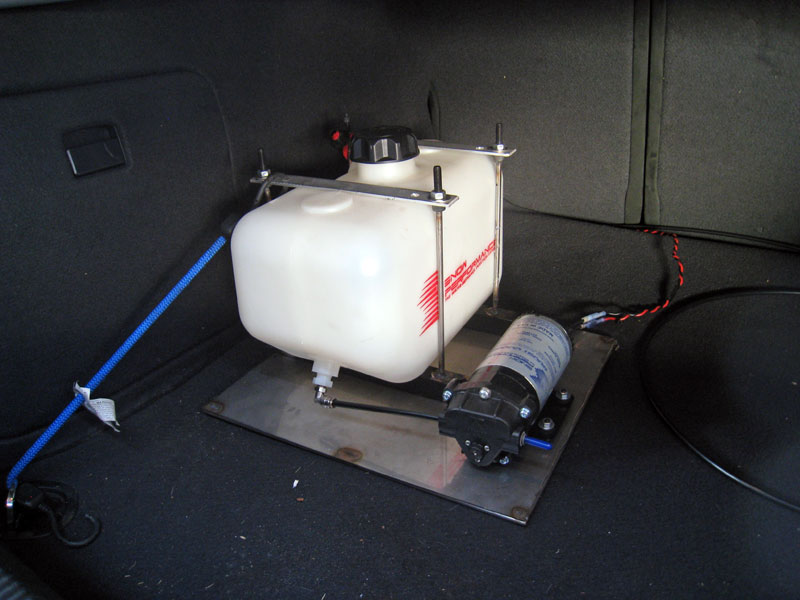
Eurodyne Boost Manager

F21 vs K04

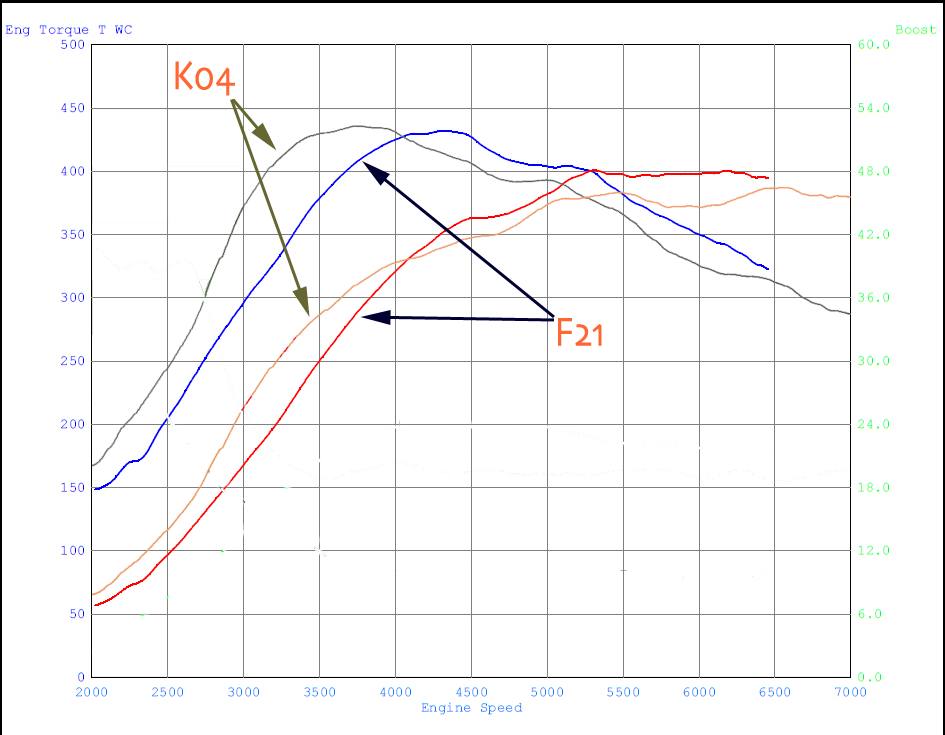
Dyno charts for F21 equipped cars are hard to come by but I did find one tuned by EPL that has some usefulness in comparing the F21 to K04’s.  The comparison is limited in the upper region due to the F21 car using K04 wastegates, but based upon the larger compressor size of the F21 and capacity to hold at least 25 psi out to red line I would expect a proper F21 setup to perform even better than the example below toward the top end – ie past 5000 rpm.

What is of most interest to me in this particular comparison case is the lower rpm region, below 4000 rpm.  I’ve seen boost logs of F21’s and noted that boost comes on more slowly than with the FT F4H-BT which was very similar to the K04, not surprising given the closer sizing of the compressor wheels in the F4H and K04.  I am a bit surprised at the torque differences shown by this F21 car and the K04 car.  I’ve seen other K04 dyno logs from EPL tuned cars as well as 034 tuned k04 cars and the torque curve is typical.  With only one F21 log to compare it’s good to be cautious in taking these results as representative, but assuming this is a fair comparison there is a decent shortfall in torque from the F21 as compared to the K04 in the sub-4000 rpm range.

This particular rpm region is significant when the car is driven in what I consider a conventional manner, that is one where high rpms aren’t being held often and downshifting in order to accelerate is not desired.  The torque advantage of the K04 will translate into a perception of greater response, though the F21 is no slouch, still there is around a 50 ft-lb difference at 2500 rpm which grows to a 75 ft-lb difference through approximately 3500 rpm.

FrankenTurbo F21 vs Borg-Warner K04
Dyno chart of EPL tuned FrankenTurbo F21 vs Borg-Warner K04

These results while being quite interesting haven’t swayed me to eliminate one turbo or the other – they do highlight how much turbocharger selection can affect the end driving experience and the importance of establishing a priority of what criteria are to be met.

  • Borg-Warner K03
  • Borg-Warner K04
  • Project B5: RS4-X
  • FrankenTurbo F4H-BT
  • FrankenTurbo F21
  • Borg-Warner RS6-K04
  • Project B5: RS6-X
  • JHM RS6-R
  • LOBA Motorsport LO530P
  • Silly Rabbit Motorsport RS6 K24
  • TiAL Sport s605.2
  • Garrett GT28RS
  • TiAL Sport R770
  • Single Turbo Kit

Next: Turbocharger Selection Big Picture

Turbo Selection – E85

Regardless of the turbocharger that is selected an E85 specific tune will be considered for use.

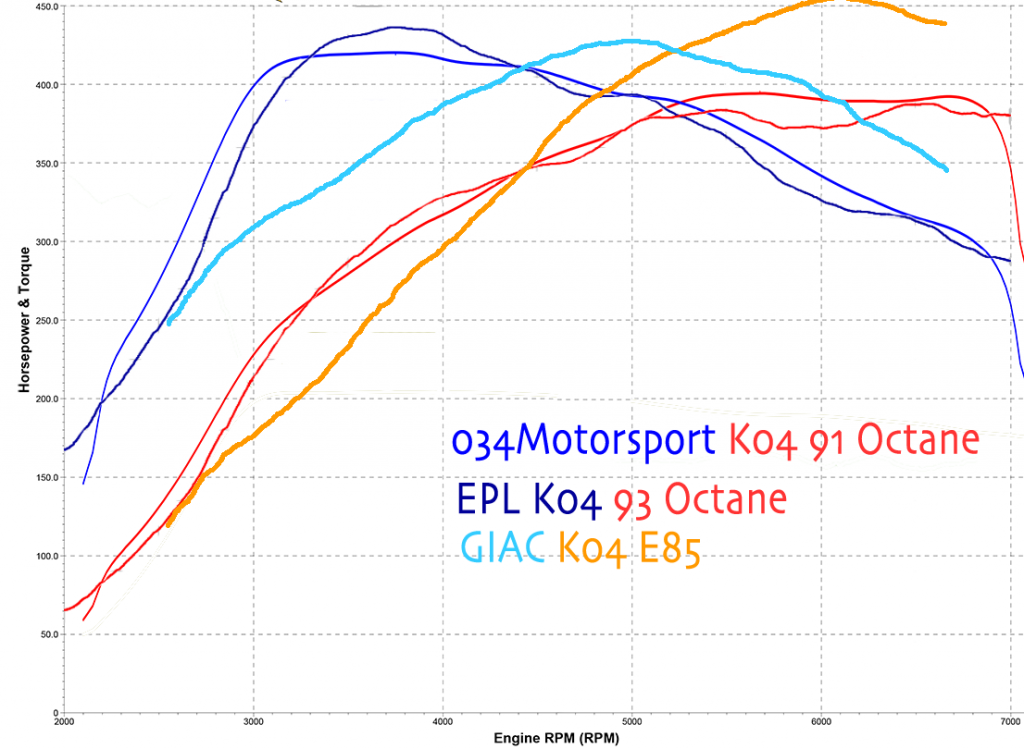
To gauge how a K04 setup may benefit from running on E85 I compared dyno charts from tunes produced by EPL, 034, and GIAC.

The EPL tune used 93 octane fuel, the 034 tune used 91 octane, and the GIAC tune used E85. Specific boost profiles and summary of aftermarket components employed by the respective vehicles was unknown.  Additionally the data comes from different dyno’s under different conditions – minor differences should be ignored – any major differences could be legitimate indicators of how the pump gas (91 and 93) cars compare with the E85 powered car.

Overlaying the three dyno charts produced the following composite:

91 versus 93 versus E85 Based on prior information about gains available to the B5 S4 by using E85 fuel the significant increase in wheel horsepower is not surprising, though still impressive.

What is a surprising is the shift in peak torque shown by the E85 fueled car, occurring nearly 1200 rpm later than the gasoline powered vehicles.

The reason for this is unknown, but one possible explanation is a slower onset of boost pressure with the GIAC tune as compared to the EPL/034 tunes.  If this is a cause, why it was done, if it was a decision, or if it is an characteristic of using E85 fuel with the K04 turbo’s, is another unknown.

Getting back to the question of turbocharger options, and weighing the results above, the next question I have is how does E85 fuel affect and RS6 size turbo with regards to spooling up the compressor.  If a similar delay is caused that would make the RS6 turbo even less responsive, and less desirable to me if an E85 tune is something I anticipate using often.  On the other hand, if the RS6 turbo is less effected due to an already delayed boost onset, as compared to K04’s, the delayed torque onset results shown above would be less important.

This new information is helpful but has raised more questions for me than have been answered.

The options remain:

  • Borg-Warner K04
  • FrankenTurbo F21
  • Project B5 RS6-X