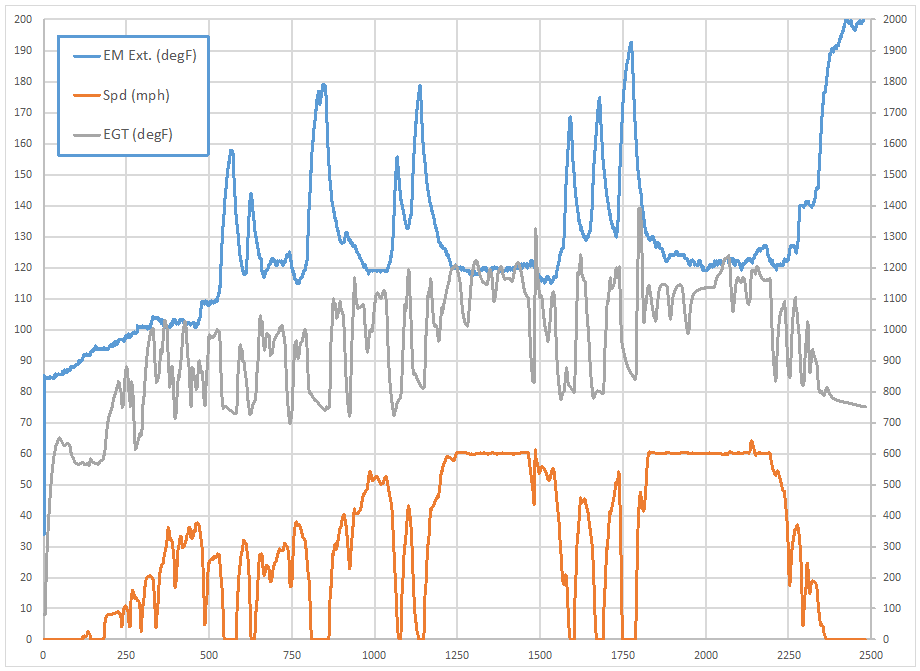
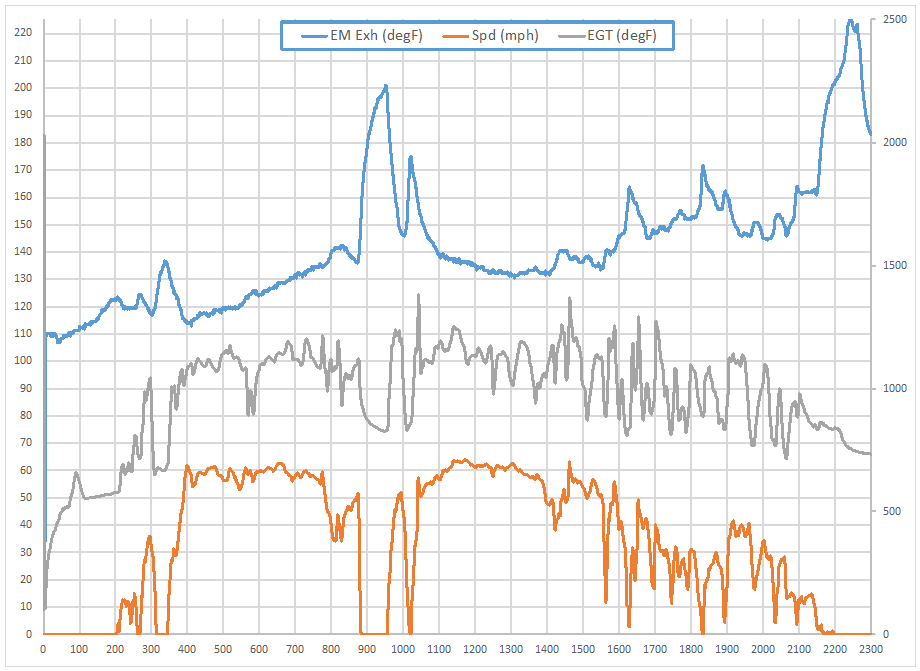
Today I made a couple of drives logging the temperature near the exhaust manifold, approximately 2.25″ from the exhaust manifold to the temperature sensor probe, and of the exhaust gas temperature inside the exhaust manifold.
The charts below were taken with ambient temperatures of 85F and 94F, top and bottom chart respectively.
The charts show the vehicle speed and temperature outside of the exhaust manifold along the left vertical axis, and the right vertical axis is the scale for the exhaust gas temperature. The horizontal axis is time in seconds.
Exhaust Manifold Temperature Readings – 85F ambientExhaust Manifold Temps – 93F ambient
The exterior temperature spikes when the vehicle slows, where the quantity of cooling air would decrease.
I’ve been interested in learning if putting a thermal coating on the exhaust manifolds makes any significant difference in the temperature radiated from the exhaust manifolds.
As luck would have it I have a set of ceramic coated exhaust manifolds, but at the time that I had acquired them I was on a tight schedule replacing turbo’s on the S4 and so I had not been able to establish some good baseline data.
Additionally I’ve found that people modifying theirs cars are a very optimistic group. If I was to use an Infrared thermometer to take external temperature readings of the exhaust manifold at various points in time, and find no difference between the thermally coated manifolds and stock uncoated manifolds, the optimists would pronounce that the surface temperature of the exhaust manifold is not important, it is what happens to the temperature of the gasses inside the exhaust manifold that matters. If I was to measure the exhaust gas temperature of the thermally coated manifolds against the stock manifolds and find no difference, then what would really matter would be underhood temperatures, that would of course be lower since the thermal barrier slows the passage of heat from the interior to exterior of the exhaust manifold, even though the surface temperature might be the same between the coated and uncoated manifolds.
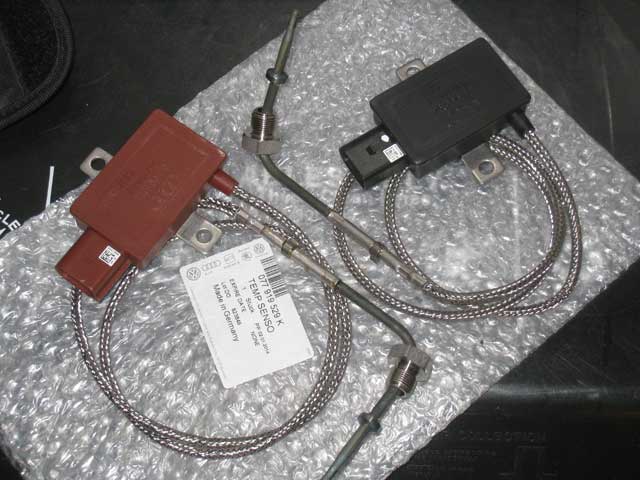
Desiring to be thorough with the next opportunity to do this evaluation I assembled a few additional sensors so that I could check readings better. On hand I now have an Infrared thermometer, an air temperature probe, a high temperature K-type thermocouple, and RS6 exhaust gas temperature sensors installed on my S4 to record the full range of exhaust gas temperatures.
Audi RS6 EGT Sensors for B5 S4
I also have a stock set of exhaust manifolds currently installed on my S4 and a set of ceramic coated exhaust manifolds available for installation at my earliest convenience.
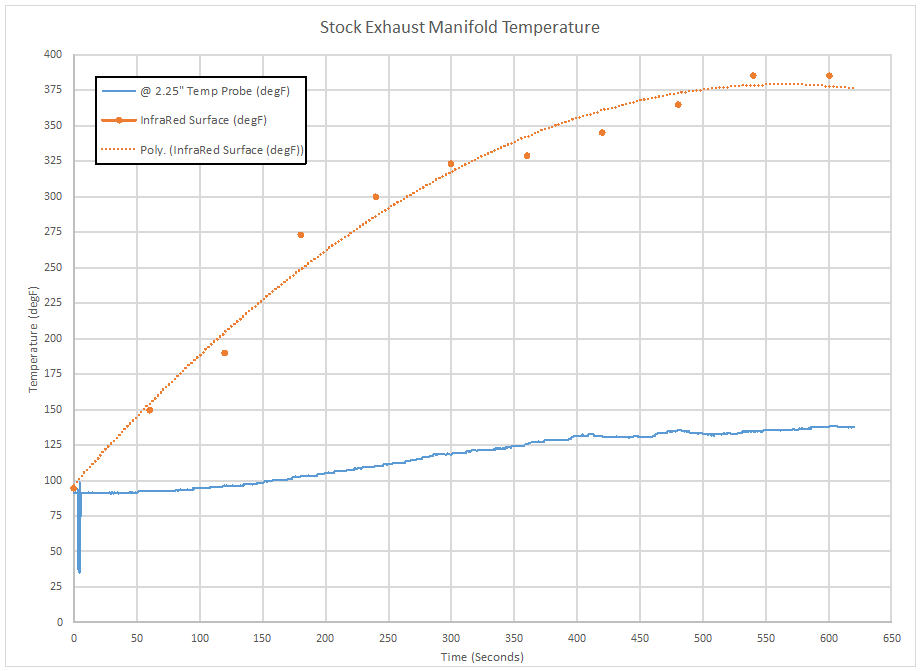
As a warm up for the more thorough testing I started my car with the air temperature probe placed 2.25″ from the exhaust manifold and took readings every minute with the Infrared thermometer to produce the chart below.
Finally, after a number of attempts to get the BoostManager software to register an RPM signal I had success tapping into a previously used wire that connects to a fuel injector. Eurodyne was very helpful throughout the process offering suggestions on where to try tapping the wire.
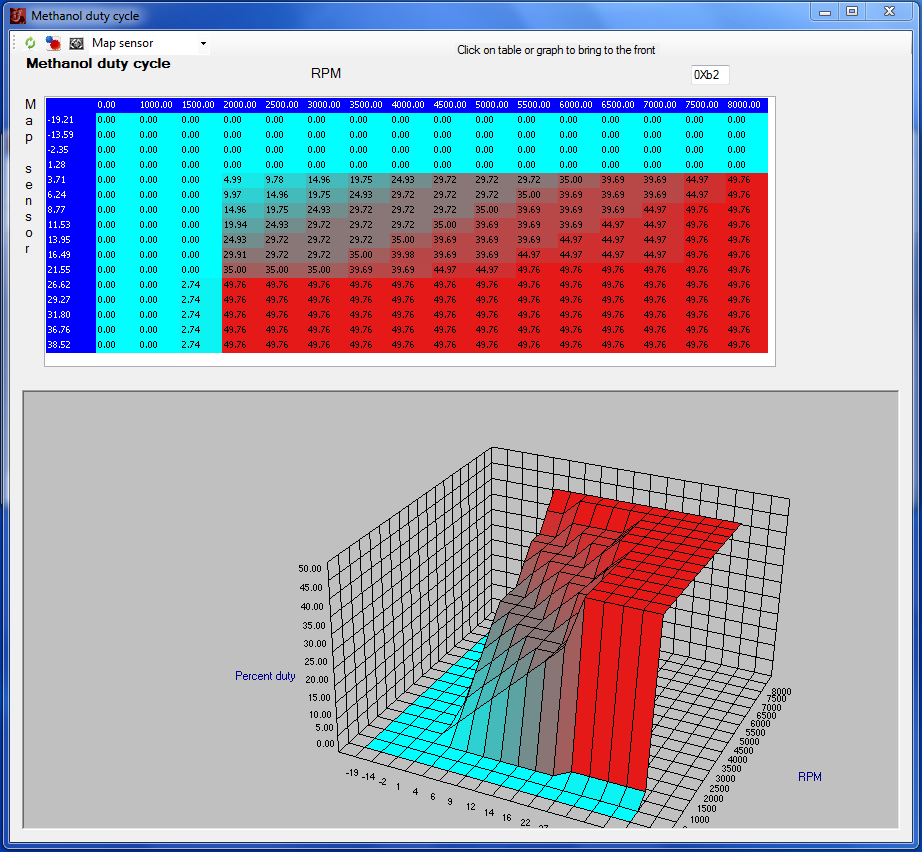
With the manifold pressure and rpm now being sent to the controller I can start to fine tune the water-methanol pump duty cycle table to better pair up with the K03 airflow and injector fuel flow.
Using the Injector Duty Cycle as a rough guide along with manifold boost pressure I setup the following table:
Next up I’ll be logging the car to see if I have any recurrence of the bog I previously experienced.